Irish nationalism and patriotic martyrdom
Angela's AshesIrish nationalism and patriotic martyrdom are presented as an inherited ideal that gives the father’s stories and family rituals their heroic language, while also exposing the strain between patriotic ceremony and the children’s material hardship. Through Cú Chulainn, the 1916 rising, rebel songs, and repeated demands that his sons promise to die for Ireland, national memory enters the household as both imaginative inheritance and an obligation imposed on children.
Legend and national inheritance
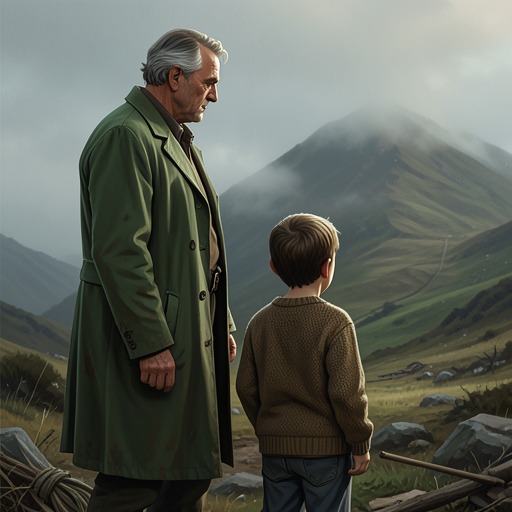
The father introduces the young Frank to Cú Chulainn by insisting that he pronounce the name correctly before hearing the story. He recounts how the hero, first called Setanta, accidentally kills Culain’s guard dog and offers to protect the household in its place. Setanta then takes the name Cú Chulainn, the Hound of Culain, and becomes a protector whose renown extends beyond the household. The father ranks him above Hercules and Achilles and imagines him capable of facing King Arthur and his knights. The legend thus supplies a heroic standard grounded in Irish tradition and sharpened by comparison with English figures.
The story is intimate as well as national: the father tells it to Frank, who sits on his lap and tastes his tea, and Frank understands that his father cannot tell it to the other children in the crowded building. Later, the father takes Frank to the General Post Office in Dublin to see the statue of Cú Chulainn, erected in honor of those who died in 1916. He explains that the hero fought to the end, as the men of Easter Week did, and that his enemies approached only after a bird landed on him and drank his blood, confirming his death. The visit joins legendary self-sacrifice to a modern memorial, making the statue a point where the father’s private storytelling meets public commemoration.
Patriotism as a household ritual
The father repeatedly turns nationalist language into a family performance. When he returns without the wages after his job has entered its third week, the household has bread and tea while other working families eat supper. The mother asks him not to disturb the children, who are already half hungry, but he calls them his troops and warriors and offers each a nickel for promising to die for Ireland. He names Francis, Malachy, Oliver, and Eugene as the Red Branch Knights, the Fenian Men, and the IRA, transforming the boys into successive ranks of imagined national defenders.
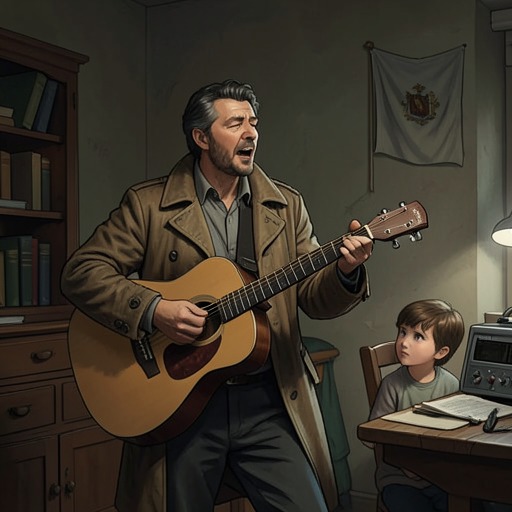
The ritual recurs in a more private, late-night scene after the father has been away hunting for cigarettes. He wakes Frank and Malachy, has them stand at attention in the kitchen, and asks for their promise. The boys agree, and the family sings “Kevin Barry”; later, he asks again whether they will die for Ireland, and they answer that they will. Their pledge is tied to the father’s grief for Margaret, the sister who died, through his suggestion that they will meet her in heaven. Patriotic sacrifice and family bereavement are therefore placed in the same imaginative frame: death for Ireland becomes a promise repeated among children who have already experienced the loss of a sibling.
The father’s rhetoric also draws on rebel song. On another Friday night when he has brought no wages home, he arrives singing “Roddy McCorley” and again summons the boys as soldiers. He says he wants them ready for the day Ireland will be free from the center to the sea. The mother’s resistance makes the domestic cost unmistakable: she points out that they have gone to bed hungry while he has spent money on whiskey. His vision of national freedom remains powerful in language, but it does not provide the family’s missing wages or supper.
Historical memory and political claims
The father presents patriotic identity not only through legend and song but through his account of his own political past. After returning from America with his wife and four children, he seeks help from Mr. Heggarty, claiming that he fought with a Flying Column during the Troubles and had to be smuggled out of Ireland because a price was on his head. He also says that he is raising his sons to love Ireland. When the official finds no record of his service in the book and refuses immediate assistance, the father condemns the new Ireland as a place of little men and paperwork, contrasting administrative proof with the sacrifice he says he made.
That confrontation shows how patriotic identity is tested by institutions and poverty. The father invokes past service while asking for help in the present; the official, unable to verify it, offers only money for the bus back into the city and a promise to look into the claim. The father then asks whether the coins could be increased enough to buy a pint. The scene does not settle the truth of his account, but it makes the gap between heroic national memory and present dependence part of the episode’s force.
The General Post Office visit supplies a different kind of public encounter with the same history. The driver questions what the statue of Cú Chulainn has to do with the men of 1916. The father answers through analogy: the legendary hero’s enemies waited until they knew he was dead, just as the men of Easter Week fought to the end. The driver responds skeptically, observing that it is a sad day when Irishmen need a bird to tell them a man is dead. The exchange puts the father’s reverent interpretation alongside a more doubtful view, without removing the emotional importance the statue holds for Frank.
Ideals under pressure
The book repeatedly places patriotic aspiration beside the practical rules that govern the family’s prospects. When the family considers what to do after returning from America, the grandfather warns that a returning emigrant cannot immediately claim the dole and must wait, leaving the family to face the interval without assured support. At the Labour Exchange, the mother’s intervention in collecting the relief money violates the convention that a woman should not interfere with a man’s dole. At school, the children are asked whether they are Americans, and their speech marks them as outsiders; the masters also require Irish-language answers for the pupils’ names, prayers, and requests to use the lavatory. National belonging thus appears not only as heroic history but as a set of economic, social, and linguistic pressures.
The father’s nationalism is especially stark when measured against his family’s material circumstances. The sons are enlisted in imagination as warriors, yet the father’s lost wages leave them hungry; the Ireland of the heroic story is celebrated while the family encounters poverty, institutional scrutiny, and suspicion of the father’s northern accent. When shopkeepers refuse help, some object to his accent and to his bringing a child along to ask for food. His appeal to the spirit of Christ does not overcome their rejection. The contrast does not make patriotism merely false or empty: the father’s stories offer Frank a vivid inheritance, and the statue visit gives that inheritance a concrete place. But the repeated pledges also reveal how national sacrifice can be demanded from children in a home where their most immediate needs remain unmet.
Narrative significance
Patriotic martyrdom works in the memoir through recurrence rather than a single declaration. The father’s story of Cú Chulainn, his songs, his naming of the boys as warriors, his account of political service, and his visit to the memorial all return to the idea that Ireland’s freedom is secured through endurance and death. The child’s responses move between imaginative absorption and the immediate facts of family life: Frank is happy listening on his father’s lap and moved by the statue, while the household scenes repeatedly place the boys’ pledges against hunger and the absence of wages.
This contrast makes nationalism both an emotional bond and a source of tension. The father passes on a language of courage, historical memory, and belonging, but he also asks his sons to inhabit that language through promises they are too young to evaluate. The memoir’s juxtaposition of heroic legend with domestic need preserves the ideal’s power while showing the cost of treating patriotic martyrdom as a ready answer to the precarious demands of everyday life.